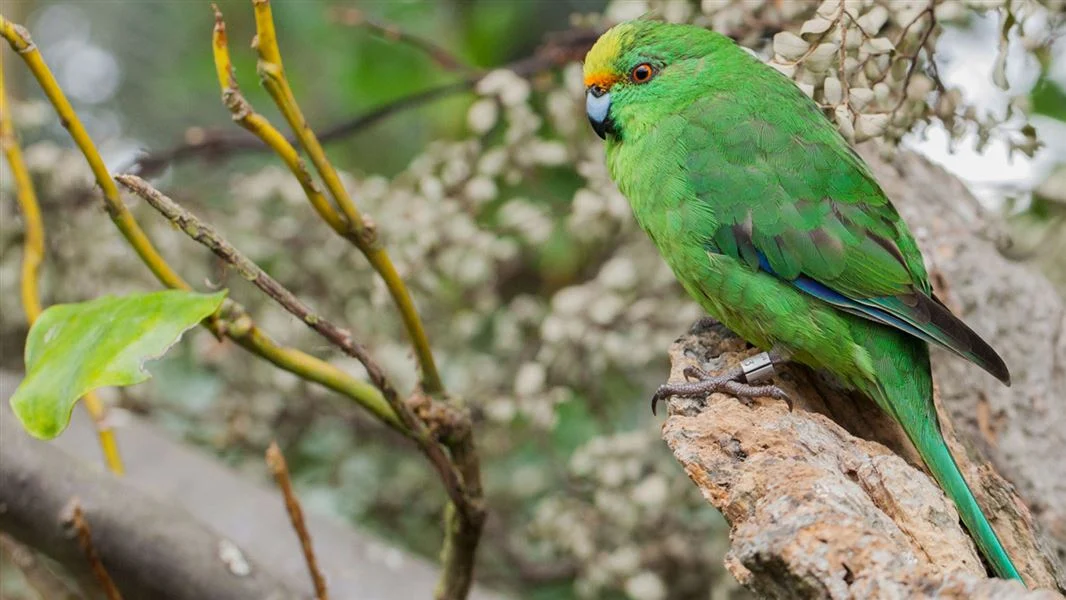
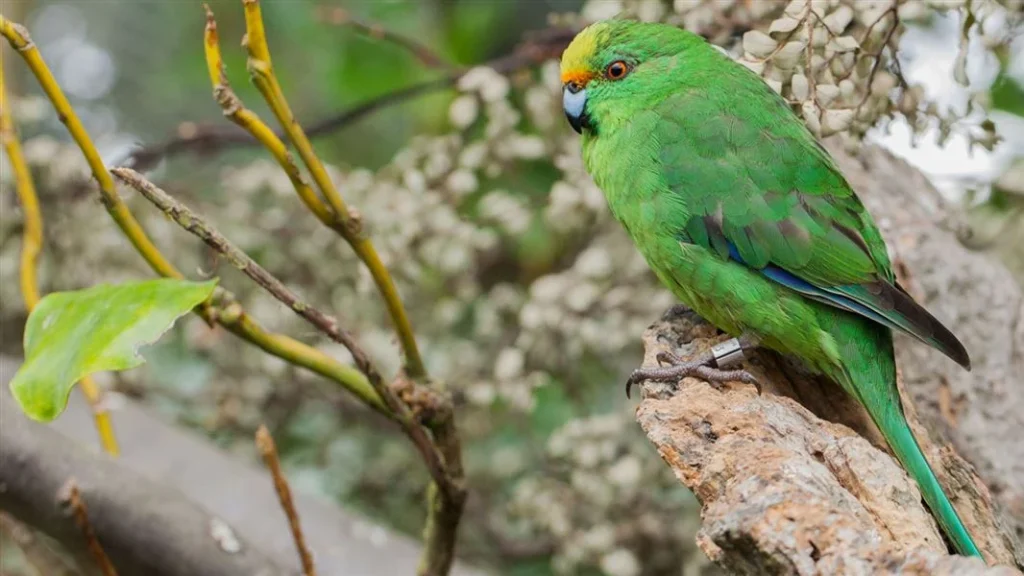
Kākāriki Karaka (orange-fronted parakeet). Image: Department of Conservation, New Zealand
If you’re lucky enough to spot a kākāriki karaka, it feels a little magical – a tiny burst of green and gold weaving through a beech valley, the small orange band above its beak glowing like a sunrise. Once found through much of Te Waipounamu, this precious taonga is now one of Aotearoa’s rarest birds.
Today, their survival depends on how well we manage introduced predators – and how thoughtfully we care for their forest home. For Connovation, humane, effective, and science-led pest control is all about protecting species like the kākāriki karaka while honouring kaitiakitanga across our whenua.
Let’s look at why this tiny parrot is so extraordinary, what threatens it, and how careful pest control is giving it a fighting chance.
Meet the kākāriki karaka – a tiny parrot with a remarkable story
The kākāriki karaka (Cyanoramphus malherbi) is the rarest of all Aotearoa’s parakeets. Weighing just 40–50 grams, with vibrant green plumage and its distinct bright orange frontal band, it’s a bird full of personality – but surprisingly hard to see among dense forest foliage.
A species treasured by tangata whenua
For Ngāi Tahu and many others, kākāriki karaka are deeply valued taonga. Their presence in the ngahere reminds us of the rich biodiversity that once flourished throughout the South Island.
A beech-forest specialist
These parakeets rely heavily on the seed cycles of our beech forests, particularly in Canterbury’s Hawdon, Poulter, and Hurunui Valleys. During beech mast events – when trees produce large amounts of seed – kākāriki karaka can successfully raise more chicks.
Critically endangered and hard to count
Despite major conservation work, wild numbers remain very low. Their cryptic behaviour makes monitoring challenging, and their rarity means every breeding season counts.
Why introduced predators pose such a danger
The biggest threat to the kākāriki karaka is predation by introduced mammals – species the parakeet simply didn’t evolve alongside.
Rats: The top threat
Ship rats are particularly damaging because they:
-
Climb easily into nesting cavities
-
Prey on eggs, nestlings, and even adults
-
Boom in population after beech mast events
Just one predator pulse can dramatically impact a small parakeet population.
Stoats: Agile, fast, and efficient
Stoats move quickly across the landscape and can find nests even in remote valleys. Even low numbers can cause significant losses during breeding seasons.
Possums and habitat pressure
Possums change forest structure, compete for nest cavities, and alter food webs. Their browsing affects beech forest health, which in turn affects the parakeets.
Low numbers mean higher risk
When populations are tiny, even a single predator incursion can undo years of conservation work. That’s why targeted, ongoing pest management is so essential.
The good news – conservation efforts are creating real hope
Despite their critically endangered status, the kākāriki karaka is far from lost. A range of committed organisations are working together to protect and restore this species.
Captive breeding and recovery
The Isaac Conservation & Wildlife Trust, working closely with DOC and partners, has bred thousands of kākāriki karaka. These birds have helped stabilise wild populations and provide crucial backup for future recovery.
Safe havens through translocations
The species has been released into several predator-free environments, including:
These sites act as strongholds while mainland recovery continues.
Intensive predator control in key valleys
In Canterbury, targeted predator control protects nests, boosts breeding success, and gives chicks the best chance of survival.
Smarter monitoring tools
New research methods – including acoustic monitoring and refined survey techniques – are improving population estimates and helping conservation teams respond quickly to threats.
Where Connovation fits – humane as possible pest control grounded in science
Connovation’s work centres on a simple philosophy: pest control can protect biodiversity while remaining as humane as possible, targeted, and guided by robust science.
This aligns perfectly with the needs of kākāriki karaka recovery – where sensitive habitats and endangered wildlife require extra care and precision.
Our preferred actives reflect our values
We focus on tools and technologies that support biodiversity protection, including:
-
First-generation anticoagulants such as diphacinone – effective, widely trusted, and well understood.
-
High-dose Vitamin D₃ – valued for its fast action and more humane characteristics.
These actives support predator management programmes while aligning with our commitment to responsible, science-led practice.
Partnering for conservation outcomes
Whether assisting with safe deployment strategies, providing high-quality baits, or supporting community and agency-led projects, Connovation’s role is to help deliver pest management that supports taonga species like the kākāriki karaka.
How you can help protect kākāriki karaka
You don’t have to be a scientist or a ranger to make a difference. Every action supports the broader recovery effort.
Support the organisations working on the front lines
Groups such as:
all rely on public support to continue their mahi.
Get involved in predator-free initiatives
Join local pest-control groups, support fenced sanctuaries, or help maintain traplines near your community.
Choose more humane, evidence-based pest control
For landowners, farmers, and professionals, using quality, well-designed pest-control tools protects both biodiversity and animal welfare.
Share the story
Raising awareness helps increase support for conservation – and keeps species like kākāriki karaka in the public eye.
A hopeful future – if we act together
The kākāriki karaka remains one of Aotearoa’s most threatened birds, but its story is also one of remarkable perseverance, dedicated conservation, and community action.
With ongoing support, careful predator management, and collaboration grounded in kaitiakitanga, we can ensure this bright little parakeet continues to flutter through our beech forests for generations to come.
If you’d like to talk about more humane, effective pest-control strategies that support conservation outcomes, the Connovation team is always happy to help.