
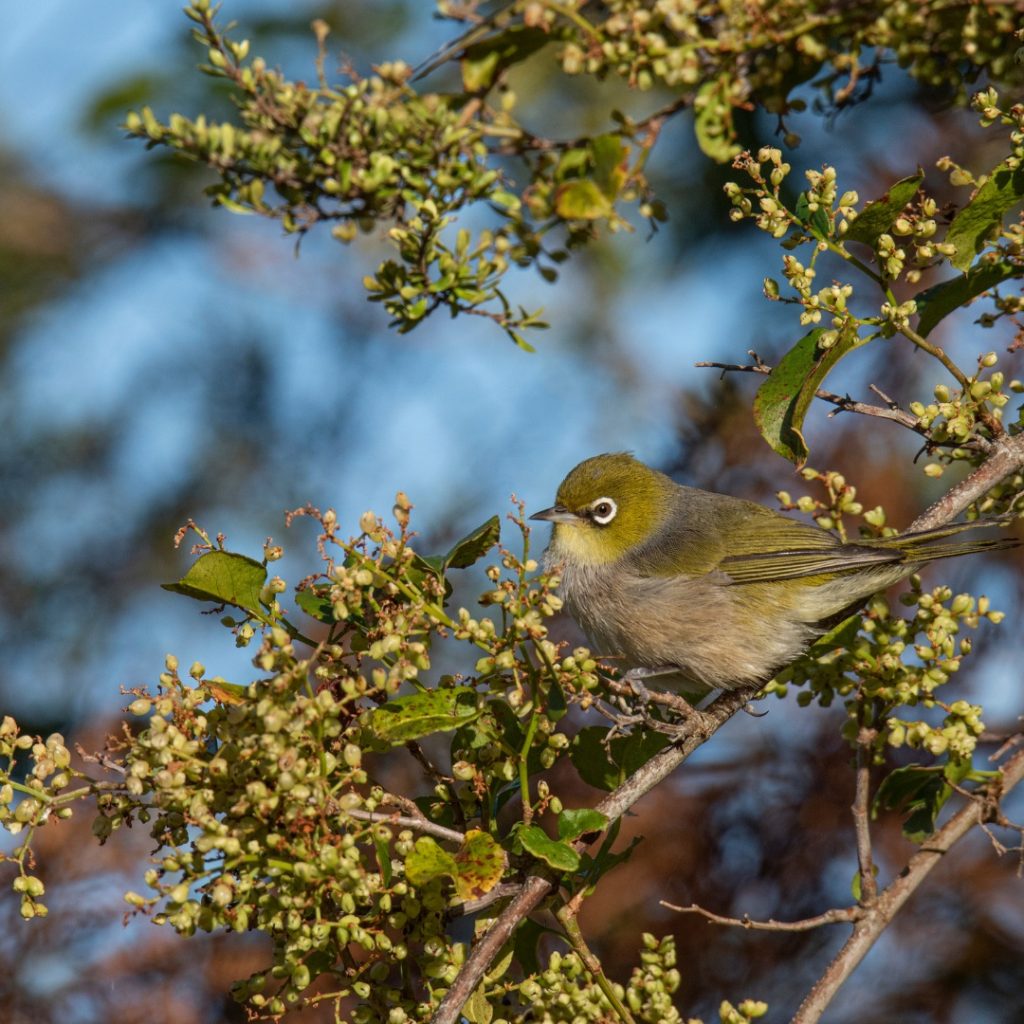
You’ve most likely seen them before: the little bird flitting through the trees of your garden or local park, with its melodic trills and warbles. Slightly smaller than the common sparrow, these small green birds, called Silvereyes, can be hard to spot amongst the foliage. They are one of our non-threatened native species here in New Zealand – and play an important role in the native ecosystem.
Meet the Silvereye
The Silvereye (Zosterops lateralis), also known as tauhou, wax-eye, or occasionally “blight bird”, is a common bird species found throughout New Zealand. The Māori name, tauhou, translates to ‘stranger’ or ‘new arrival’.
While this bird originally migrated from Australia in the 1800s, there is no evidence of human involvement or intention in the process. Since they showed up of their own volition, they are still classified as a native species.
Their olive-green and cream plumage, with the distinctive bright white ring around their eyes, makes them easily identifiable around the country. While not quite so abundant in the deeper parts of the forest or in open grassland areas such as the Otago plains, these friendly little birds are regulars in most vegetated areas: coastal regions, forests, even your backyard.
Like many other native birds, they are prey to the usual introduced predators such as cats, rats, and stoats. Since the Silvereye is still thriving in numbers, there are no specific preservation efforts underway for their specific benefit. However, the work that goes into protection of rarer, threatened species with the same predators naturally contributes to the wellbeing of the whole ecosystem.
The Silvereye & the Ecosystem
Like with most species, there are both positives and negatives that come from the involvement of the Silvereye in ecosystems, particularly on the native plants they affect.
The alternative name “blight bird” comes from the fact that silvereyes feed on aphids and codling moth caterpillars, which helps protect plant life from the damage they can cause. They are also very helpful in getting some of our native species to thrive by:
On the negative side of things, Silvereyes are known to cause damage to small or ripening fruit, such as grapes and apples. Orchards and vineyards often cover their plants to protect the ripening harvest from bird damage, which includes damage caused by Silvereyes. Their ingestion of small fruits can also lead to the spreading of weed seeds.
A Brief History of Bird Pollination
“Tiakina nga manu, ka ora te ngahere Ka ora te ngahere, ka ora nga manu”
“Look after the birds and the forest flourishes. If the forest flourishes, the birds flourish.”
Since the late 1800s, only decades after the Silvereye’s arrival, early ecologists were influenced by European ideas that bird pollination is “not important” to the survival of the native ecosystem. In Europe, there were few bird-pollinated plants. This was around the same time that rats, stoats, and weasels were being introduced to Aotearoa, proving a threat to native bird species and significantly reducing their numbers.
This ideology persisted into the late 20th century, with ecologists claiming that, while New Zealand does have some native plants for which birds are the primary pollinators, the decline in bird population would not have a negative effect on pollination or the survival of those species.
It wasn’t until the 1990’s/early-2000’s that ecologists became concerned, upon discovering certain plants and shrubs whose pollination was failing due to declining bird numbers. Contrary to earlier assertions, it appeared that insects would not fill in the gaps when native birds were not around to pollinate – or in the cases where insects could perform the pollination, they were far less effective at it.
Even with research into the possibility of exotic birds helping with pollination, bellbirds, Silvereyes, and tūī were still performing 89% of the visits to native plants. While pollination by birds is not necessarily a common feature of plants, there are still certain native plants that require it, and more still that benefit from it.
Protecting the Silvereye
Thanks to their fine tapered bill and brush tipped tongue, similar to the bellbird and tūī, Silvereyes are one of the main bird species participating in pollination in New Zealand. While the Silvereye is currently in a good position in terms of population, it is important that we are doing what we can to make sure these and other native birds are kept safe.
DOC is always implementing plant and animal pest control measures that increase the quality of whole ecosystems. But what can you do to help in your local area? Some possible actions include: