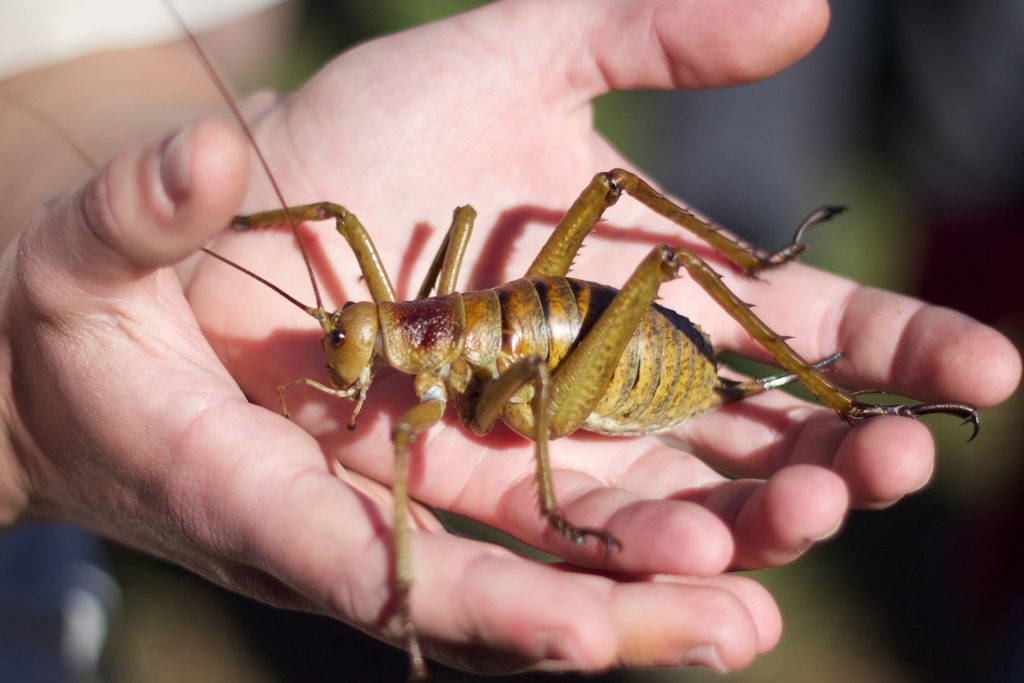
Image credit: By Dinobass – Own work, CC BY-SA 4.0, https://commons.wikimedia.org/w/index.php?curid=42040205
If you have spent time in the protected forests or delved into the caves around our fair country, chances are high that you have seen a distinctive armoured body, spiny legs, and reaching antennae. Only found in New Zealand, wētā outdate even the tuatara, with experts putting their origin at 190 million years ago. Although there are more than a hundred species of wētā, 16 of these are at risk – including some of our largest.
Wētā are incredible looking creepy crawlies, and one of New Zealand’s most easily recognised. They are generally already considered large for insects, but one group of wētā exceeds expectations.
Giant wētā are, naturally, the larger species. The largest of these can weigh up to 35 grams – comparable to, if not heavier than, a common mouse or sparrow. Before land mammals were introduced to Aotearoa, giant wētā filled the role that rodents do now.
There are 11 species of giant wētā, most of which are no longer found on the mainland, and many of which are endangered. One of the biggest insects in the world, they are endemic to Aotearoa (meaning they are found nowhere else in the world).
So who else is going to ensure their survival?
The name given to the largest of the giant wētā is wētāpunga – Punga being the god of all things repulsive and ugly in Māori mythology. These admittedly weird looking creatures are lucky to have survived.
There have been many threats to wētā over the last several centuries that were not a concern for much of their existence.
Rats, mustelids, cats, and hedgehogs: just some of the species that humans brought with them to an unwitting Aotearoa. While the wētā evolved with known native predators, such as birds, reptiles, and bats, introduced species such as these have seen a marked increase in predation rates.
And the human impact doesn’t stop there. Much of the natural habitat of the wētā has been destroyed or modified by human settlement and exploration.
Several wētā species are now only found on offshore islands. Presumed extinct on the mainland, wētāpunga are only found on Little Barrier Island. At least, they were only found there.
The wētā has become an icon of invertebrate conservation in New Zealand, with several programmes in place to aid some of the threatened species to survive.
Due to successful breeding and translocation projects, Tiritiri Matangi and Motuora Islands are now also home to wētāpunga.
In a collaborative effort (including the Weta Recovery Group alongside the Department of Conservation, Auckland Zoo, and Butterfly Creek) hundreds of wētāpunga have been bred and reared, ready for release onto island sanctuaries in the Hauraki Gulf. Since 2010, a couple of islands in the Hauraki Gulf Marine Park have received these wētāpunga to significantly boost the population.
A single location made them more vulnerable, as a catastrophe on Little Barrier would have otherwise wiped them out forever. Establishing the species on several islands greatly increases the chance of the species surviving into the future. The other key element of these islands is that they are pest-free.
Predation by invasive mammals is one of the largest threats to wētā in New Zealand. Their size, in this case, is a shortcoming, as it makes them a bigger target and prevents them from fleeing as effectively. Our management of their predators is instrumental in their survival. Pest control becomes essential.
At Connovation, we consider it our duty to focus on tools and technologies that target pests while still protecting the taonga species that are unique to Aotearoa, and therefore are our responsibility to help. The purpose of our science-led practices, resulting in humane and effective pest management, is to protect our native species, honouring the Māori ideal of kaitiakitanga.
With help, we can work towards a Predator-Free 2050. Whether you’re choosing quality pest control tools, supporting sanctuaries and programmes, or spreading the word, we are all part of the team. Working together, there is hope for many of our native species.
Who knows? The giant wētā may be able to take back its rightful place in the mainland ecosystem.