
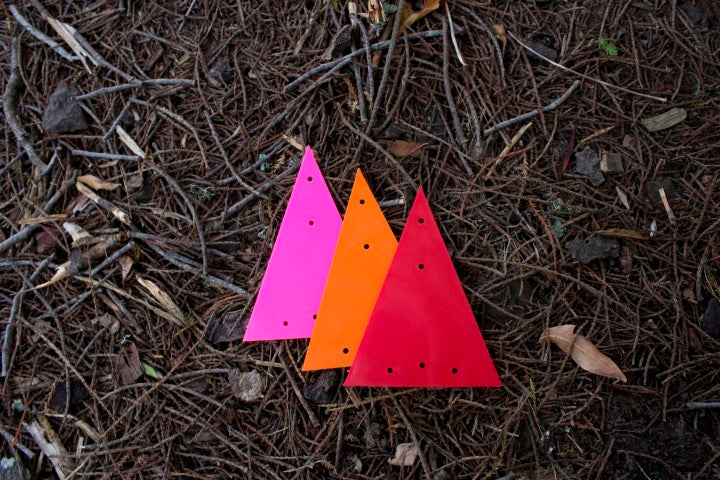
$124.99 incl GST
Triangle Markers are used to mark trap lines, bait stations, monitoring sites, or operational boundaries so they’re easy to find and follow during pest‑control work. Their bright colour and simple shape make them highly visible in bush, farmland, and forestry environments.
Find your traplines and bait station sites easily in large areas of forest or bush by marking them with these highly visible triangle markers.
Place the markers on trees or posts near these sites, or at track entrances and exits.
For more options, see our range of conservation tools.
Place Triangle Markers where they will clearly guide you or your team along trap lines, at bait station sites, monitoring tunnels or chew card locations, at track entrances or junctions, or on trees, posts, or fences. Space markers at consistent intervals so the line is easy to follow.
Triangle Markers can be attached using staples, nails, screws or cable ties (for fences or wire). Make sure the marker is firmly fixed and facing outward for maximum visibility.
If your operation uses multiple lines or bait types, you can colour‑code markers to indicate trap line numbers, bait type or toxin used, monitoring vs control lines and start/end points. This helps teams navigate quickly and reduces confusion.
During operations, replace any markers that fall off or become obscured, trim vegetation if needed, ensure markers remain visible from one to the next. Clear marker visibility improves safety and efficiency.
Some operations require markers to be removed afterward, especially in public areas or temporary control zones. Collect and reuse markers where possible.
Triangle Markers are used to mark trap lines, bait stations, monitoring sites, and operational boundaries so they’re easy to find and follow during pest‑control work.
They make trap lines highly visible, reduce time spent searching for stations, and help ensure consistent spacing and accurate navigation—especially in dense bush, farmland, or forestry blocks.
Attach markers securely to trees, posts, fences or stakes as appropriate. Use staples, nails, screws, or cable ties. Position them so they face outward and are easy to see.
Place markers at eye level for maximum visibility. In dense vegetation, mount them slightly higher to avoid being obscured.
Markers should be spaced at consistent intervals so the next marker is visible from the previous one. Adjust spacing based on terrain and vegetation density.
Yes. They can be removed at the end of an operation and reused for future lines or monitoring work.
Yes. They are suitable for forest and bush, farms, lifestyle blocks, conservation areas or urban edges Their bright colour ensures visibility in low‑light or dense vegetation.