


$99.00 – $632.50Price range: $99.00 through $632.50 incl GST
Save yourself time and effort with RatAbate Strikers – a ready-to-use product that effectively controls rats.
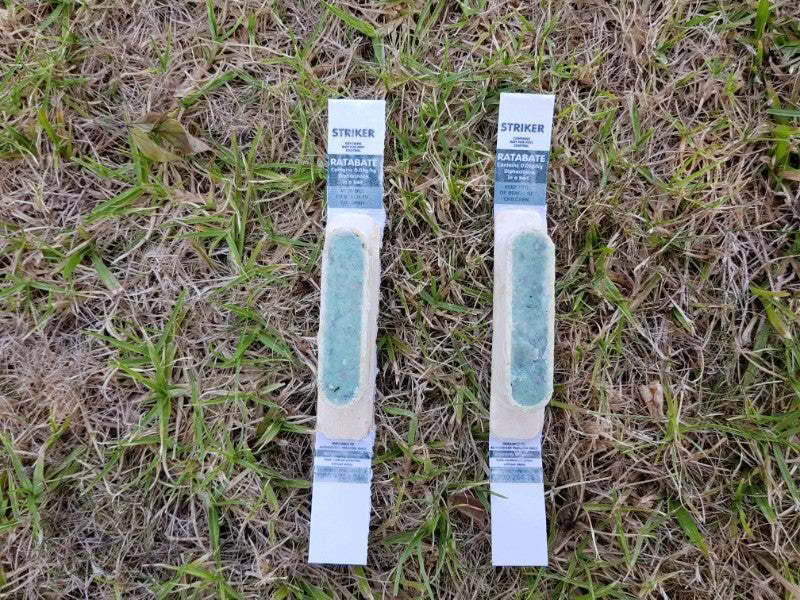
One RatAbate Striker = 18g of Ferafeed 213 non-toxic paste with Diphacinone added. This sits in a biodegradable, potato starch bait station on a weatherproof card.
The low risk of secondary poisoning from first-generation anticoagulants like Diphacinone makes them a great choice for farm situations and the environmentally conscious.
Use RatAbate Strikers in one-off or short-term pest control situations where you don’t need permanent bait stations. They’re easy to use – just staple them onto trees or suitable posts.
For more options, see our range of rodent control products.
*how long a substance takes to reduce its concentration by half
Read the Safety Data Sheet (SDS), which is available on our website. Put gloves on before applying.
Put on gloves and staple strikers into place by affixing directly to trees and fence posts, or staple inside permanent bait stations through the area where there is evidence of rats being present.
Strikers strategically placed will prevent access and predation by non-target animals and protect the bait from the weather. Position strikers at heights that will not be easily accessed by children, domestic pets or stock.
To help prevent Striker tags from breaking, carefully select a suitable surface to staple to, and use longer staples in the staple gun. If using in managed forests, make sure you check with the Forest Manager for any special requirements for attaching to trees.
The number of strikers to place will depend on the rat infestation, and how frequently the bait uptake is to be checked and baits renewed. A good guide is to place 3 to 3 strikers no less than 75m between sites in continuous habitat. In cases of high rat densities, check the Striker lines at two-day intervals in the first instance to ensure there are sufficient remaining. Where Strikers have been entirely eaten replace with fresh Strikers. Where Strikers have been partially eaten leave in place and insert the equivalent number of new Strikers. When Strikers are being eaten at a consistent rate, this signifies a high rat population in that area and the quantity of Strikers at each site must be either increased or additional Strikers be placed. Perhaps scale back and check stations at three-day intervals if bait take is reduced, or if there is a low to medium rat population.
Ratabate strikers contain 18g of Ratabate paste in a biodegradable bait station, with relevant warnings printed. Ratabate is a high‑quality, toxic paste bait used to control rats. It is highly palatable to rats and designed for use in permanent bait stations or strikers.
RatAbate contains Diphacinone, a first‑generation anticoagulant. Its short half‑life means it carries a much lower risk of secondary poisoning, making it suitable for farms and environmentally conscious users.
RatAbate Paste has been used to control rats in New Zealand since 2006, giving it a long, proven history of effective performance.
Diphacinone has a short biological half‑life — around 3 days in tissue and blood. Compared with Brodifacoum (130–300 days), this means:
Because RatAbate Paste contains only 0.05% diphacinone, a dog must eat a large amount of paste to reach a dangerous dose. The risk depends heavily on the dog’s size.
Small dogs (5–10 kg) are at the highest risk because their body weight is low, and would need to eat 200–400 g of paste to reach a potentially dangerous dose. This is equivalent to most or all of the paste inside a bait station.
Medium dogs (10–25 kg) would need to eat 400–900 g of paste. This usually means multiple bait stations or a large tub of paste. Accidental poisoning is uncommon unless a dog gains direct access to stored bait.
Large dogs (25–40 kg) would need to eat 1–1.5 kg of paste. This is significantly more than a dog could access from a properly used bait station. Large dogs are at lower risk from single‑event ingestion.
Very large dogs (40+ kg) would need well over 1.5 kg of paste. Primary poisoning is unlikely unless the dog consumes a large quantity of loose or spilled bait.
Important Notes
Our advice is always to contact a vet urgently if you suspect your pet has ingested any toxin.
When used correctly in bait stations, RatAbate Paste presents minimal risk to native birds and non‑target species due to its short half‑life and reduced secondary‑poisoning potential.
Why do birds eat RatAbate Paste?
RatAbate Paste contains grains and sugars that attract rats—but these ingredients also appeal to many bird species. Birds will readily sample paste if it is accessible.
How can I reduce bird access to paste bait?
Use Ratabate paste in permanent bait stations with bird exclusion steps taken as follows: